
Data centres should be planned as energy infrastructure, not just digital infrastructure
Data centres have become one of the defining infrastructure challenges of the decade. They power the cloud, artificial intelligence, public services, financial systems and the everyday digital services that modern economies depend on. In the UK, they are now formally recognised as Critical National Infrastructure. That puts them in the same category as energy and water in terms of national importance. The UK is now the world’s third-largest data centre market, behind only the United States and Germany.
But data centres are not only digital assets. They are major energy assets. They draw a large and continuous electrical load, and they release just as much heat. The next generation of facilities should not simply ask, “How do we connect to the grid?” It should ask, “How do we strengthen the local energy system?” The aim is for digital growth to support sustainable, low-carbon electricity across the UK and Ireland, not strain it.
Why it matters
Integrating data centre waste heat recovery into the wider energy system creates a clear opportunity for the UK and Ireland. Instead of venting waste heat to the atmosphere, operators can capture it and use it to heat homes and buildings. In London alone, which hosts around 80% of the UK’s data centre capacity, AECOM estimates that the heat currently lost could warm up to half a million homes.
The scale of demand is what makes this urgent. Data centres currently account for around 2.5% of the UK’s electricity, and the House of Commons Library expects this to rise four-fold by 2030. The global picture is similar. The International Energy Agency estimates that data centre electricity use will more than double, from around 415 TWh in 2024 to roughly 945 TWh by 2030. That is close to 3% of global demand, growing at about 15% a year, with AI the single biggest driver.
At this scale, the demand is an opportunity as much as a challenge. Captured and reused, the heat data centres produce could improve energy security and cut emissions rather than going to waste.
Standalone data centres are clearly needed, and that need is accelerating as AI adoption grows. The question is how they are planned. Done well, a data centre is more than a consumer of electricity. It is a continuous source of recoverable heat, a potential anchor for local heat networks, and a long-term asset that can support regional decarbonisation.
Reframing the role of data centres
New and existing data centres should be viewed as anchor energy assets. This is already beginning to happen across the UK and Ireland. In practice, that means seeing them in three ways:
As major electricity users that require security and resilience.
This makes them central to grid planning and local energy strategy.
As heat-producing assets.
The heat generated by servers is usually treated purely as a cooling problem. With the right infrastructure, it becomes a valuable source of low-carbon heat for nearby homes, public buildings, hospitals, education campuses, leisure centres and commercial developments.
As a catalyst for wider energy investment.
This could range from energy centres and heat networks to thermal storage, heat pumps and control systems.
The following projects show what becomes possible when a data centre is treated as a heat source and grid asset, not only a digital facility.

In Ireland, Echelon Data Centres is developing its DUB20 campus in Arklow, County Wicklow, as the country’s first Green Energy Park. This is a model defined under the Irish Government’s Large Energy Users Action Plan (LEAP), which co-locates large energy users with renewable generation and storage. The campus is designed to run primarily on renewables. A joint 220kV substation developed with SSE Renewables will unlock up to 800MW of offshore wind from Arklow Bank Wind Park Phase 2, supported by onsite solar PV generating more than 6,000 MWh a year and battery storage. Two onsite energy centres will provide grid support, one of them able to export power to the national grid when renewable output is low. Hydrotreated vegetable oil (HVO) will replace conventional fuel to cut onsite generation emissions by up to 90%. Construction is under way, with completion targeted for 2028.
Learn more
In the UK, the Old Oak and Park Royal Energy Network (OPEN) in West London shows how data centres can support low-carbon heat when they are designed into a wider energy scheme. The network is led by the Old Oak and Park Royal Development Corporation and designed by AECOM. It will capture waste heat from nearby data centres and pipe it to more than 10,000 new homes, 250,000m² of commercial space and Central Middlesex Hospital. The first phase will recover up to 17MW of waste heat from two new data centres, with scope to connect further sites as demand grows. Backed by £36 million from the Government’s Green Heat Network Fund, it is the first scheme of its kind in the UK.
Learn moreWhy this isn’t happening fast enough
Despite the opportunity, integrated energy planning still faces real challenges.
First, timing. Heat reuse is too often treated as a connection issue rather than a design principle. Key decisions on site layout, cooling strategy and commercial structure are frequently made before heat recovery, grid capacity or local network integration are even considered. By that point, retrofitting heat recovery is far harder than designing it in from the start.
Second, fragmentation. Data centre developers, energy centre designers, heat network specialists, local authorities, utilities and grid operators often work to different timelines and different priorities. As more data centres are planned, it is essential that digital and energy infrastructure are planned together, rather than separately.
Third, speed and scale. The pace at which the UK and Ireland are expected to build new capacity places sudden and intense pressure on the electricity system. With so many data centres now in construction or in the connection queue, there is a risk that thorough planning is deferred. Integration becomes a problem to revisit once immediate demand is met, instead of a feature of the original design.
Encouragingly, new policy and a growing industry conversation are starting to address these risks.
What designing data centres as energy infrastructure looks like
The most immediate opportunity is heat. A data centre rejects heat whenever it is running, which is almost always. Unlike wind or solar, that output is steady and predictable. The catch is grade: it comes off the cooling system at low temperature, so it has to be raised to the temperature a network needs before it is useful. Where there is nearby demand and the right infrastructure, it can then feed a heat network.
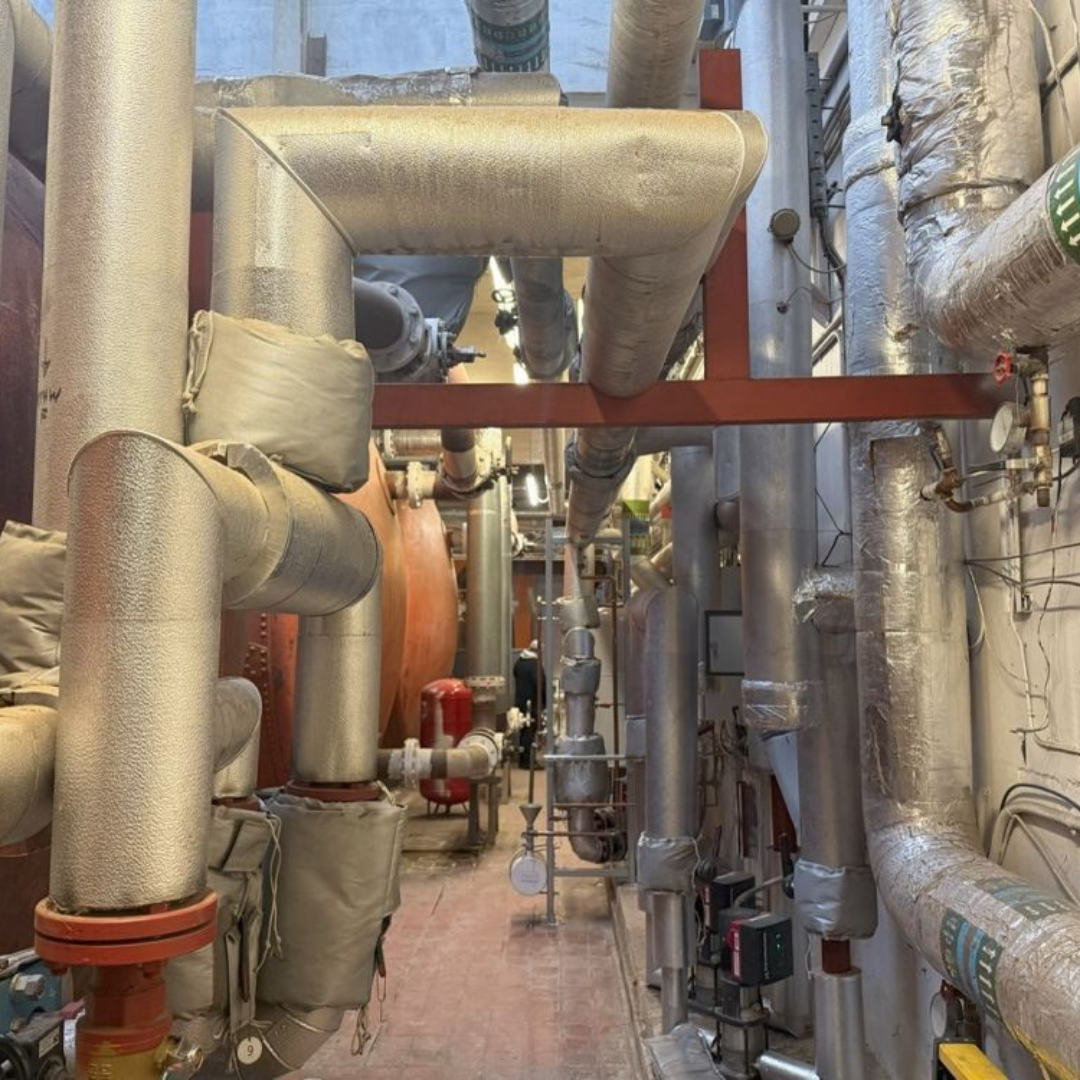
Capturing it well takes coordination. Cooling strategy, heat pump selection, energy centre specification, network temperature and customer demand are all interdependent, and far easier to align in design than to fix on site.
This is core Colloide territory: the process design, controls and plant that decide whether a network actually performs. For a data centre, it is what turns heat that would otherwise be thrown away into a low-carbon asset with a value attached.
Electricity supply is changing too. The UK Government has identified AI Growth Zones to streamline planning approvals and accelerate the delivery of clean power. The biggest single blocker for these projects is securing a timely grid connection. The Government plans to support the zones by expanding network capacity and reforming how connections are granted. That includes removing speculative demand from the queue, letting developers build their own high-voltage infrastructure in step with Ofgem, and backing every zone through the Connections Accelerator Service.
This makes hybrid power models increasingly important. They combine grid supply with private-wire renewables, battery and thermal storage, heat pumps, backup systems and smart controls. These shifts are welcome. Developers are beginning to think not only about buildings and servers, but about energy ownership, supply resilience and local generation.
The data and energy landscape keeps shifting, so a scheme built today has to cope with change. AI hardware, cooling methods and grid rules will all move. Heat demand can grow too, as new homes, buildings or industrial users connect nearby. Energy infrastructure should therefore be modular and built in stages, with headroom for extra heat sources, new connections, evolving technology and new commercial models.
Colloide plans for this. Because our plant is built in modular blocks, capacity can be added or re-sourced in stages, without tearing out what already works. A network can grow with the demand around it rather than being fixed at the size it started.
Why this is urgent now
The infrastructure decisions made today will shape energy systems for decades. The rise of AI has compressed the timeline further, because data centres can be built far faster than major grid reinforcements, heat networks or large-scale energy infrastructure. That mismatch is why heat recovery and local energy integration need to be designed in now, while these facilities are still on the drawing board.
Policy is moving in both markets. The UK is clearing the way for AI and data centre investment, through the AI Growth Zone reforms set out above. Ireland is taking a different route. In December 2025 the Commission for Regulation of Utilities (CRU) published a new electricity connection policy for data centres, opening a clearer pathway to the grid after years of de facto restriction. Under it, large data centres must meet at least 80% of their annual electricity demand with new renewable generation in the Republic of Ireland, over a six-year glide path. Renewable supply is now built into the cost of connecting. The pressure behind this is real. Data centres already account for around 22% of Ireland’s electricity, up from 5% in 2015, and are on course for roughly 31% by 2034.
This creates both opportunity and risk. The opportunity is to build data centres that strengthen local energy resilience, supply useful heat, accelerate investment in low-carbon infrastructure and help unlock constrained sites. The risk is that they are built as isolated energy loads. They add pressure to the grid while missing the chance for heat recovery, local integration and community benefit.
Colloide’s position
At Colloide, we believe data centres should be designed as part of the energy system from day one. This means bringing together the disciplines that are too often separated.
With more than 20 years across water, wastewater and renewable energy, Colloide brings process engineering capability to the core of every scheme. That covers the design, heat source integration and system optimisation that determine how an energy centre performs. The water and wastewater heritage matters here. Our process engineers understand the environment these schemes draw heat from, which makes for a cleaner interface with the heat recovery side of the system.
Colloide has built this exact engineering before, on UK-first, award-winning schemes. At the Bunhill 2 Energy Centre in Islington, a world first, we were principal design-and-build contractor. We captured the warm exhaust air from a London Underground ventilation shaft with an ammonia heat pump, adding hundreds of homes and a primary school to the local heat network. At the Viking Energy Network in Jarrow, we were principal contractor for the UK’s first river-source heat scheme, pairing a River Tyne heat pump with a 1MW solar farm, CHP and battery storage to warm eleven public buildings and cut over 1,000 tonnes of carbon a year. The common thread is low-grade heat lifted to a useful temperature. Wastewater is a key source in that line which Colloide are collaborating with Recirc Energy on, for effective and coordinated project delivery. However, the warm air a data centre throws off sits in the same category.
Colloide designs and delivers the energy centre, central plant and network plant rooms as a specialist design-and-build partner. An in-house team of designers, process and project engineers, commissioning engineers and project managers takes each scheme from concept to handover. The people who design the system are the same ones who prove it in operation, so ownership never changes hands. Plant is prefabricated and pressure-tested off-site as modular skids, then delivered ready to install. That shortens the programme on site and turns start-up into a controlled handover rather than a bespoke build in a live plant room.
The result is a single energy-centre package with one team accountable for it. Process, mechanical, electrical, controls and civils are coordinated in-house, not strung across a chain of suppliers for the client to police. Colloide can hold this scope as principal contractor, working directly with the end client, whether that is a council, a university, a hospital or an estate. We can equally work as a specialist subcontractor or consortium partner alongside larger developers and main contractors on heat networks at scale.
Data centres will remain essential to the digital economy. But whether they are sustainable and resilient depends on how well they are tied into the energy systems around them. The next generation should be judged not only by capacity, connectivity and uptime, but by how intelligently they use power, how effectively they recover heat, how well they support local energy networks, and how far they advance the transition to net zero.
Digital infrastructure and energy infrastructure can no longer be treated as separate problems. For data centres, the future is not only digital. It is energy-led.
Sources and technical references:
- International Energy Agency — Energy and AI (World Energy Outlook Special Report), 2025: global data centre electricity demand and growth.
- House of Commons Library — Data centres: planning policy, sustainability and resilience (briefing CBP-10315): UK consumption (2.5%) and four-fold rise to 2030.
- UK Government (GOV.UK) — AI Opportunities Action Plan; Delivering AI Growth Zones: AI Growth Zones, grid connection reform and the Connections Accelerator Service.
- Echelon Data Centres / RTÉ / SSE Renewables — DUB20 Green Energy Park, Arklow: 220kV substation, offshore wind, solar PV, energy centres and HVO.
- AECOM and Old Oak and Park Royal Development Corporation (OPDC), with GOV.UK Green Heat Network Fund — Old Oak and Park Royal Energy Network (OPEN), and AECOM, Optimising Data Centres in London: Heat Reuse: 17MW heat recovery, 10,000+ homes, £36m funding, and the estimate that London’s data centre waste heat could warm up to half a million homes.
- Commission for Regulation of Utilities (CRU) and EirGrid — Large Energy Users / data centre electricity connection policy (December 2025): 80% renewable requirement and Irish data centre demand share.
- Colloide — Bunhill 2 Energy Centre and Viking Energy Network Jarrow project records
** All sources referenced in this blog are properly linked within the content. If you believe any material used in this blog infringes on your copyright, please contact us, and we will address the issue promptly. If you would like to be mentioned within this content please contact [email protected]