The Heat Is Already There. Now We Need the Model to Deliver It
What industry discussions in Edinburgh and Dublin reveal about turning low-carbon heat potential into bankable, deliverable infrastructure.
Scotland and Ireland have significant sources of low-carbon heat beneath their streets, within their wastewater infrastructure and in the ground below their buildings. Identifying those resources is only the beginning. Turning them into reliable, affordable heating requires the right engineering, commercial arrangements and long-term investment.
That distinction came through strongly at two industry events in September 2026: Net Zero Projects Scotland in Edinburgh and the European Geothermal District Heating & Cooling Days in Dublin. In Dublin, Geological Survey Ireland (GSI) presented its assessment of the geothermal resource beneath the city. In Edinburgh, discussion centred on the practical barriers that stop promising net-zero projects progressing through design, procurement, financing and construction.
The technologies and markets differ slightly, but the message was consistent. The future of low-carbon heat networks depends less on finding energy resources than on developing projects that customers trust, investors can support and engineering teams can deliver.
Colloide attended both events and was an Associate Partner at Net Zero Projects Scotland, alongside Recirc Energy. Here we explore what these discussions mean for utilities, local authorities, developers and infrastructure owners.
Abundant heat, but availability does not guarantee viability
Ireland offers a clear example. According to ThinkGeoEnergy’s report of GSI’s presentation, around 94% of the country is classified as suitable or highly suitable for ground-source heat pumps. In central Dublin alone, GSI estimates that around 4.5 TWh a year of shallow geothermal energy could be available, more than four times the commercial and public-sector heat demand of the city centre.
GSI was careful to stress that these figures describe resource availability rather than immediately developable capacity. Ground conditions, drilling access, available space, heat demand and distribution infrastructure all influence what can be developed. Deep geothermal carries greater uncertainty, which is why a seismic survey announced at the conference is planned for early 2027 to improve understanding of the deep subsurface beneath Dublin.
Scotland shows how existing infrastructure can provide another source. Stirling’s district heat network has recovered heat from wastewater treated by Scottish Water since 2019, and Renfrewshire Council is delivering a networked ground-source heat pump system for council housing in Paisley.
Finding heat is only the first stage. The Sustainable Energy Authority of Ireland’s district heating guidance states that a feasibility study must cover heat demand, supply options and network design, with an analysis of financial viability, operational efficiency and environmental impact. The question is not simply how much low-carbon heat exists, but how much can be recovered, distributed and supplied reliably at a competitive cost.
Wastewater heat recovery: connecting resource and demand
Wastewater is particularly interesting because the resource already sits within infrastructure serving towns and cities. Sewers and treatment works carry water warmed by domestic, commercial and industrial activity, offering a relatively stable source for heat pumps. The UK Government’s sewer heat recovery guidance, published in January 2025, describes sewer heat recovery as “a significant opportunity for the decarbonisation of heat in urban areas”.
The presence of wastewater does not make a scheme viable on its own. Flows, seasonal temperatures, heat exchanger performance, maintenance access and the gap between source and network temperatures all shape the engineering solution, as do customer locations, distribution costs and the electricity needed to run heat pumps. Crucially, heat recovery equipment must be integrated without compromising essential wastewater operations.
These factors affect technology selection, energy-centre design, controls, commissioning and maintenance. Left too late, they become avoidable constraints during procurement or construction.
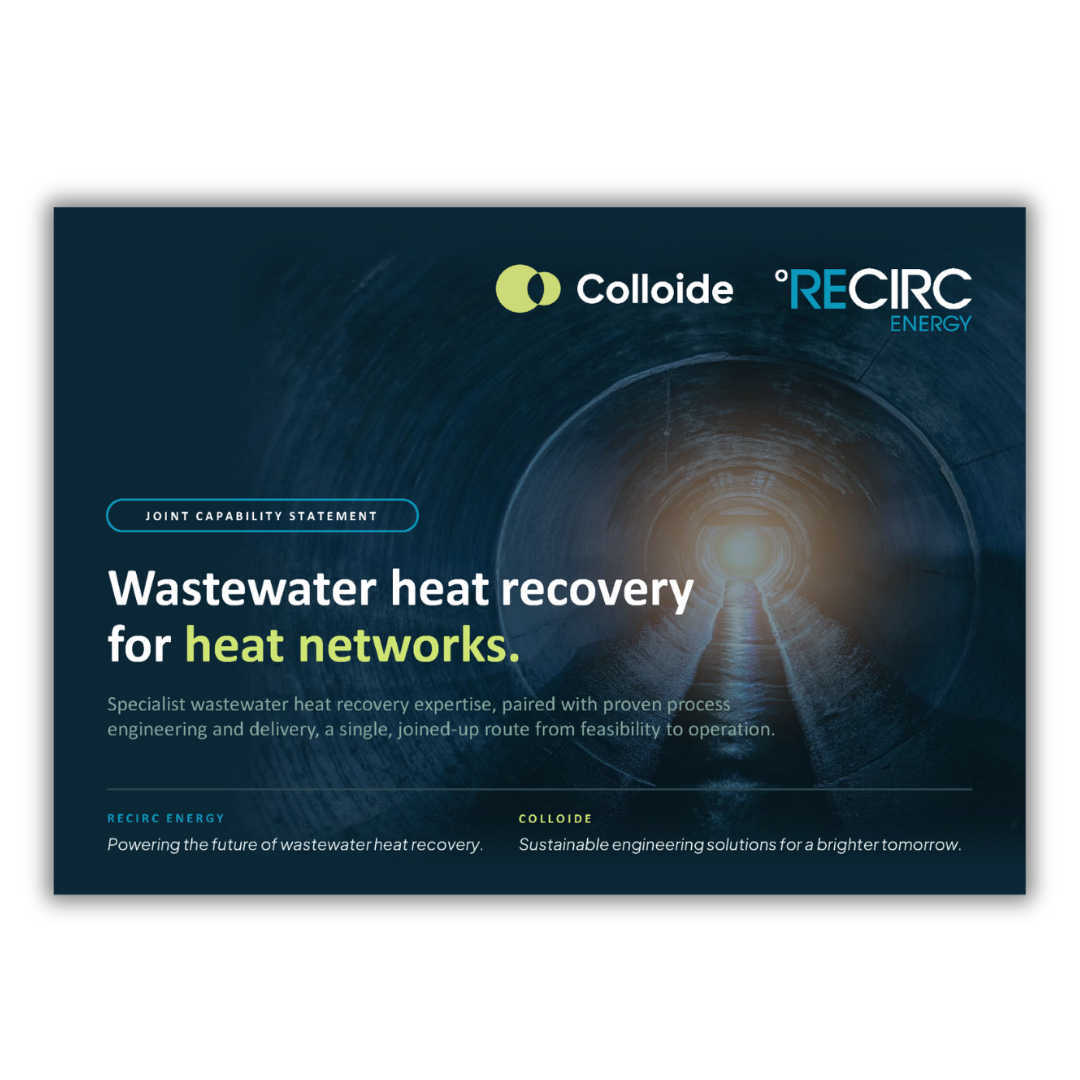
That is why Colloide and Recirc Energy are working together on wastewater heat recovery for district heating, combining Recirc’s specialist knowledge with Colloide’s process engineering, design, project management and delivery capabilities. The wider lesson for project owners is that energy recovery should be assessed as part of an integrated infrastructure system, not as an isolated technology installation.
Why early engineering involvement matters
A recurring theme in Edinburgh was the need to connect design decisions with the realities of construction and operation. Heat network projects involve many interfaces: heat sources, energy centres, distribution pipework, building connections, electrical systems, controls and existing infrastructure. Plantroom dimensions, equipment access, network temperatures, installation sequencing and commissioning arrangements all become harder and more expensive to resolve once procurement is complete and construction has started.
SEAI’s guidance reflects this by setting out project development as a sequence of stages, from feasibility through business model and procurement strategy to contracting, construction, commissioning and operation.
Early involvement allows engineering contractors to assess buildability, identify equipment constraints, review interfaces and support realistic programme planning, so that technical risks are weighed alongside commercial decisions rather than emerging during delivery. At Colloide, this reflects the importance we place on integrated process engineering and practical delivery input from the earliest stages. The aim is not to replace the designer’s role, but to test designs against installation, commissioning and operational requirements while changes remain manageable.
Customer confidence is becoming an infrastructure requirement
Technical feasibility is only one measure of success. Heat networks must also provide reliable service, transparent billing and acceptable costs, and regulation now reflects that. Ofgem began regulating heat networks across Great Britain on 27 January 2026, and operators and suppliers of existing networks must register by 26 January 2027.
Consumer Scotland’s January 2026 evidence review shows why. Drawing on earlier survey research, it reported that 25% of heat network consumers had made a complaint, compared with 6% of energy consumers overall, and only 9% were satisfied with how their complaint was resolved.
Technical expectations are rising too. The Heat Network Technical Assurance Scheme (HNTAS) is planned to launch in 2027 and will be phased in, with assessments required for existing networks as well as new ones. Correctly specified equipment, effective controls, appropriate metering and reliable commissioning therefore matter beyond engineering: they shape efficiency, service reliability, operating costs and the ability to demonstrate compliance.
Scotland’s existing networks face an optimisation challenge
The Scottish Government’s Heat in Buildings progress report, published in October 2026, estimates that heat networks supplied around 1.67 TWh in 2025, including recently commissioned projects supported by Scotland’s Heat Network Fund. The statutory targets are 2.6 TWh by 2027, 6 TWh by 2030 and 7 TWh by 2035. The same report estimates that just 11% of heat in existing Scottish networks comes from low-carbon sources, and says build-out has been hampered by the high cost of electricity and construction inflation.
That creates a dual challenge: expanding capacity while improving the carbon performance and efficiency of existing infrastructure. Support for existing networks has started to emerge. In September 2026, the Scottish Government opened optimisation study grant funding under Scotland’s Heat Network Fund. Funded studies must look at improving network efficiency, assess clean heat options for networks that rely on fossil fuels and reduce customer detriment. Applications closed on 7 October 2026, with projects to be delivered by March 2027.
The grant supports studies rather than the capital cost of upgrades, but it shows growing recognition that existing infrastructure needs attention. For operators, optimisation raises practical engineering questions about hydraulic performance, temperature regimes, controls, heat losses and metering, with direct consequences for operating costs, emissions and customer service.
Turning heat projects into investable infrastructure
Engineering readiness and customer confidence are closely linked to a third challenge: attracting investment. At the Dublin event, a finance panel discussed what makes geothermal and heat network projects suitable for debt and long-term investment. According to ThinkGeoEnergy’s coverage, speakers emphasised clarity over who owns the asset and who pays for the heat, anchor customers, an early indication of the expected heat price, at least a preliminary business case and an understanding of geological and construction risks. KPMG’s Terence McGovern pointed to heat offtake agreements of 15 to 25 years as a way to establish contracted income.
For investors, a promising resource is not enough. They need confidence that the infrastructure will generate dependable revenue. That requires credible demand data, clear commercial arrangements for customers, and defined construction and operational responsibilities, with key risks identified and allocated.
Scale matters too. Pioneer Point Partners described building a portfolio of roughly €50–60 million of investment before seeking portfolio-level financing. Combining several opportunities in a coordinated programme could bring efficiencies in feasibility, procurement and financing, although the commercial case must be established for each. Projects should be developed as long-term infrastructure services from the outset, not as equipment packages seeking funding at a late stage.
Funding the work before construction
If investors need mature, well-prepared projects, who funds the work that gets them there? The European Investment Bank’s ELENA facility can cover up to 90% of project preparation costs, such as feasibility studies, procurement preparation and project bundling, for investment programmes above €30 million. In February 2026, the EIB announced a €2.97 million ELENA grant for Belgian developer KARNO, intended to help mobilise €82.5 million of heating and cooling investment.
Scotland’s experience shows why preparation matters. According to the Scottish Government’s progress report, no new Heat Network Fund grants were awarded in 2024 due to a lack of applications successfully demonstrating that they met the funding criteria. By July 2026, the fund had awarded approximately £14 million to six projects.
These figures do not prove that development funding alone determines success, but they underline the importance of preparing schemes that meet technical, financial and programme requirements. For public-sector project owners, that means robust feasibility studies, realistic demand data, early supply-chain engagement and clear business cases.
What comes next for heat network delivery?
Several milestones will shape 2027. Existing heat networks in Great Britain face Ofgem’s registration deadline on 26 January, HNTAS is planned to launch, and Scotland approaches its first statutory heat network target.
In Ireland, the Heat (Networks and Miscellaneous Provisions) Bill would make the Commission for Regulation of Utilities the heat network regulator. The Government approved revisions to its General Scheme in July 2026, and the Bill sits in its priority drafting list, although legislative timelines remain fluid.
For project developers, the priorities are increasingly clear: understand actual heat demand, establish the viability of available heat sources, involve the relevant engineering disciplines early and develop commercial models that protect long-term performance.
The constraint has moved from identifying heat to delivering infrastructure
The geothermal resource beneath Dublin, the heat carried through Scotland’s wastewater systems and the potential of ground-source heating are more than energy discoveries. They are potential infrastructure assets, but only once projects can demonstrate technical viability, commercial resilience and reliable long-term operation.
The discussions in Edinburgh and Dublin reinforce the need to consider engineering, delivery, customer outcomes and finance together from the earliest stages. For Colloide and Recirc Energy, that supports a collaborative approach to wastewater heat recovery and district heating, bringing specialist resource knowledge together with practical engineering and delivery.
The next phase of heat network growth will be defined not by how much heat is available, but by how effectively the industry turns that potential into dependable infrastructure.
We will continue the conversation at the Net Zero Nations Projects Conference in London on Wednesday 10 February 2027, where Colloide will again be an Associate Partner alongside Recirc Energy. If you are attending, exploring wastewater heat recovery or developing a low-carbon heat network, we would welcome a conversation about how early technical collaboration can help build a deliverable scheme.
What do you see as the greatest barrier to heat network growth in Scotland and Ireland: project finance, regulatory requirements or delivery capability?